Bitcoin’s fourth halving on April 20, 2024 will slash miners’ rewards from 6.25 to 3.125 BTC per block. This built-in scarcity mechanism occurs every four years and has historically preceded significant price increases—though not immediately. Smart investors recognize both opportunity and risk: reduced supply typically drives up prices, but expect volatility. While smaller mining operations may struggle, network security strengthens through consolidation. Don’t chase FOMO spikes; understand the cycle. The halving’s true impact unfolds over months, not days.
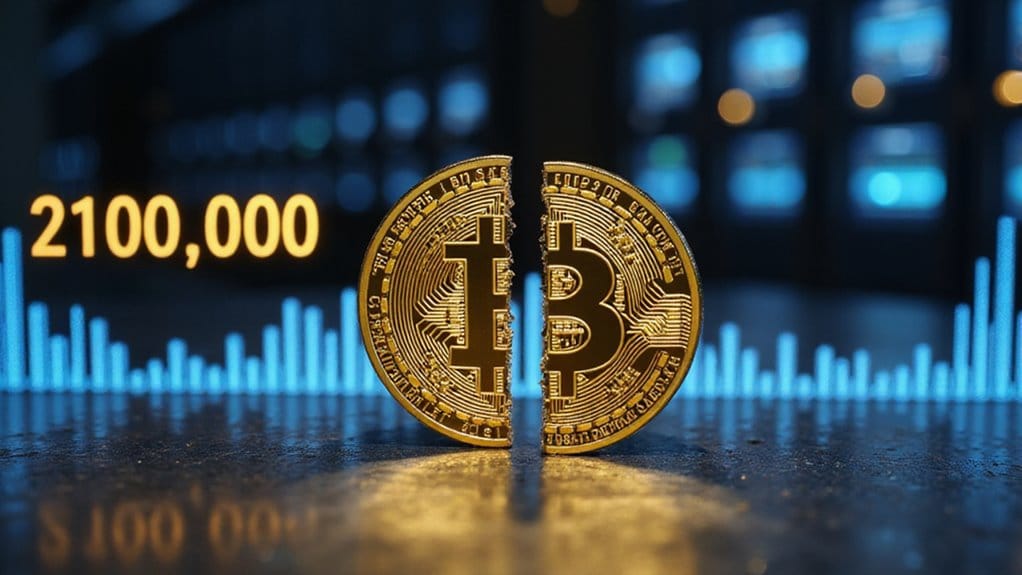
While seasoned crypto enthusiasts might already have April 20, 2024 marked on their calendars, newcomers to the Bitcoin world may wonder why this date matters at all. This seemingly arbitrary day represents Bitcoin’s fourth halving event, when miners’ rewards dropped from 6.25 to 3.125 Bitcoins per block. It’s not just a technical adjustment—it’s a fundamental economic event that happens approximately every four years.
Think of halving as Bitcoin’s built-in scarcity mechanism. Every 210,000 blocks, the reward for mining new blocks gets slashed in half, systematically reducing the rate at which new Bitcoins enter circulation. This controlled restriction of supply is precisely what makes Bitcoin behave more like gold than traditional currency. With a hard cap of 21 million coins (we’re already at 19.7 million), each halving pushes Bitcoin further toward its deflationary destiny.
Bitcoin’s automated scarcity protocol ensures its deflationary nature, creating digital gold through systematic supply reduction.
Previous halvings have sparked significant market movements. The 2012, 2016, and 2020 events each preceded considerable price increases—though not immediately. The first halving on November 28, 2012 reduced rewards from 50 to 25 BTC per block. Don’t expect overnight riches; the market typically needs time to absorb the new supply dynamics.
For investors, halvings present both opportunity and risk. The reduction in new supply can drive up price over time, but heightened speculation creates volatility that’s not for the faint-hearted. Your best move? Understand market cycles rather than chasing FOMO-driven spikes. Implementing proper risk management practices is crucial to protect your investments from the extreme volatility often seen around halving events.
Miners feel the halving impact most directly. With rewards suddenly cut in half, smaller operations often struggle to remain profitable. The industry consolidates, favoring large-scale operations with efficient equipment and cheap electricity. This consolidation ultimately strengthens Bitcoin’s network security. Once all Bitcoin is mined, miners will rely exclusively on transaction fees for income, creating a new economic model for network security.
Looking ahead, future halvings will continue until approximately 2140, when all 21 million Bitcoins will have been mined. Each event reduces inflation and increases Bitcoin’s scarcity—potentially enhancing its appeal as a store of value.
Whether you’re planning to invest, trade, or simply observe, halvings remain vital signposts on Bitcoin’s journey toward mainstream adoption.
Frequently Asked Questions
How Does Halving Affect Bitcoin’s Energy Consumption?
Halving reduces Bitcoin’s energy consumption by forcing out inefficient miners who can’t profit under tighter margins.
When rewards drop, miners must upgrade to more efficient equipment or find cheaper energy sources—often renewables. This economic pressure drives industry-wide efficiency improvements.
The resulting technological innovation means newer mining rigs consume less electricity per hash.
However, this green shift comes with a trade-off: increased e-waste from discarded older mining equipment as hardware quickly becomes obsolete.
Can Halving Trigger a Market Crash Instead of Growth?
Yes, halving can potentially trigger a market crash rather than growth.
While history shows post-halving price increases, nothing’s guaranteed in crypto. The reduced mining rewards could force smaller miners to sell their holdings to cover operational costs, flooding the market with supply.
Excessive pre-halving speculation might create unrealistic expectations that, when unmet, lead to disappointment and selling pressure.
Market psychology matters—if enough investors expect a crash after halving, their collective actions could make it reality.
How Do Mining Pools Adapt to Halvings?
Mining pools adapt to halvings through multiple survival tactics.
First, they upgrade to more efficient hardware—old machines just won’t cut it anymore. They also relocate to regions with dirt-cheap electricity (hello, hydroelectric power!).
Many pools diversify their revenue streams by offering cloud mining services or maintenance packages. Some even consolidate with larger operations for economies of scale.
The smart ones? They’ve planned for this years in advance, stockpiling resources and optimizing operations well before the reward drop hits.
Does Halving Impact Bitcoin Transaction Fees?
Halving events indirectly impact Bitcoin transaction fees through market dynamics.
After halvings, miners receive fewer block rewards, potentially prompting them to prioritize higher-fee transactions to maintain profitability. The most recent halving saw fees spike temporarily to $170 before settling around $9.
Long-term fee trends depend on network congestion, adoption rates, and implementation of scaling solutions like Lightning Network.
Savvy users can minimize costs by batching transactions or timing them during periods of lower network activity.
Are Altcoins’ Prices Correlated With Bitcoin Halving Events?
Yes, altcoin prices typically correlate with Bitcoin halving events, but indirectly.
When Bitcoin surges post-halving, investors often shift profits to altcoins, creating what traders call “alt season.” Historical data shows this pattern repeating after previous halvings.
The correlation isn’t immediate though—altcoins usually lag behind Bitcoin’s initial pump by weeks or months.
Smart investors watch for Bitcoin’s price stabilization as their signal to contemplate rotating some gains into promising altcoins.