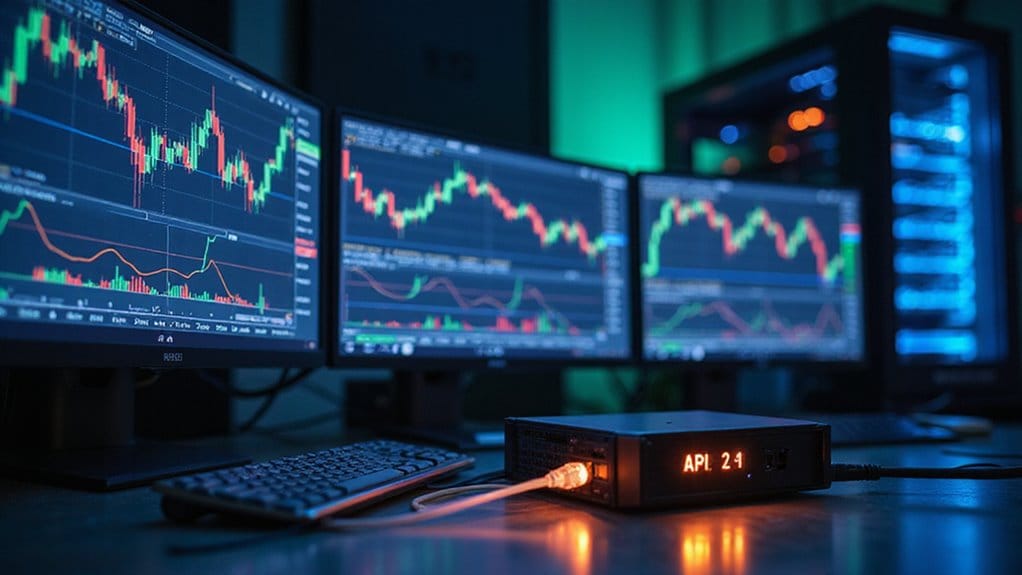
Bitcoin mining requires significant investment in specialized ASIC hardware—forget using your laptop. You’ll need cheap electricity (under $0.05/kWh), mining software like CGMiner, and membership in a mining pool to stand any chance of profitability. The process involves solving complex SHA-256 puzzles against increasingly difficult odds, currently at a staggering 103.919 trillion difficulty level. Solo mining? Pure lottery. For most beginners, joining a pool offers the only realistic path to earning those precious satoshis.

Diving into Bitcoin mining requires more than just a laptop and a dream. It’s a complex process that involves verifying transactions and securing the Bitcoin network while potentially earning rewards. Gone are the days when anyone could mine profitably with basic equipment—today’s mining landscape demands specialized knowledge and resources.
First, you’ll need an ASIC miner. These purpose-built machines outperform regular computers by a mile, with hash rates that make your gaming rig look like a calculator. Don’t even think about GPU mining for Bitcoin; that ship sailed years ago.
Still determined? You’ll need to shell out anywhere from $500 to several thousand dollars for competitive hardware.
Electricity costs will make or break your mining operation. Miners flock to regions with rates under $0.05 per kWh because, let’s face it, these machines are power-hungry beasts. Calculate your potential profitability before buying anything—many enthusiastic miners end up paying more for electricity than they earn in Bitcoin.
Next, choose mining software to manage your hardware and connect to the blockchain. Programs like CGMiner or BFGMiner are popular choices. Install the software, join a mining pool (because solo mining is basically a lottery with terrible odds), and configure your setup.
Mining pools combine resources from multiple miners, increasing your chances of earning consistent, albeit smaller, rewards. The total supply cap of Bitcoin is limited to 21 million coins, making mining increasingly competitive as we approach this ceiling.
The mining process itself involves your hardware solving complex mathematical puzzles using the SHA-256 algorithm. Your machine adjusts a value called a “nonce” until it finds a block hash that meets the network’s difficulty target. The mining difficulty currently reaches approximately 103.919 trillion, making the odds of successful mining increasingly challenging for individual miners.
This entire system operates on the Proof-of-Work consensus mechanism, which ensures network security by making it prohibitively expensive for malicious actors to attempt to alter transaction records.
Sound complicated? It is—and it gets harder every time the network difficulty adjusts.
Frequently Asked Questions
What Hardware Gives the Best Mining Performance per Dollar Spent?
The Bitmain Antminer S21 Hyd offers exceptional value with 335 TH/s at $4,200, providing strong performance per dollar. The MicroBT WhatsMiner M50S also delivers competitive efficiency at 126 TH/s for $2,999.
How Much Electricity Will Bitcoin Mining Add to My Bill?
Bitcoin mining’s electricity cost depends on miner efficiency, electricity rates, operation scale, and runtime. Consumption can range from hundreds to thousands of kilowatt-hours monthly, potentially adding significant costs to electric bills.
Is Mining Bitcoin Legal in All Countries?
Bitcoin mining is not legal in all countries. China, Nepal, Kosovo, Algeria, Morocco, and Angola have banned cryptocurrency mining due to concerns about energy consumption, financial regulations, and grid stability.
Can I Mine Bitcoin on My Smartphone?
While technically possible, smartphone Bitcoin mining is impractical. Devices lack sufficient processing power compared to ASICs, resulting in negligible earnings that don’t justify battery drain, device strain, and electricity costs.
How Often Do Miners Actually Find Blocks and Earn Rewards?
Individual miners rarely find blocks alone due to network competition. Mining pools find blocks approximately every 10 minutes, with rewards distributed among participants based on their contributed hash power to the pool.