Cryptocurrency mining turns your computer into a digital money-maker through solving complex puzzles. Start with decent GPUs like the Nvidia GTX 1660 Super, guarantee you have a 600W+ power supply, and join mining pools like BTC.com for consistent earnings. Calculate potential profits against electricity costs before diving in—mining isn’t free money! Proper cooling prevents hardware meltdowns, while staying updated on industry trends keeps you competitive. The journey from curious beginner to profitable miner awaits those willing to learn.
Diving into cryptocurrency mining can transform an ordinary computer user into a digital-age prospector. The process might seem challenging at first, but it’s fundamentally about solving complex mathematical puzzles to verify blockchain transactions and earn rewards. Those rewards? Sweet, sweet cryptocurrency coins and transaction fees.
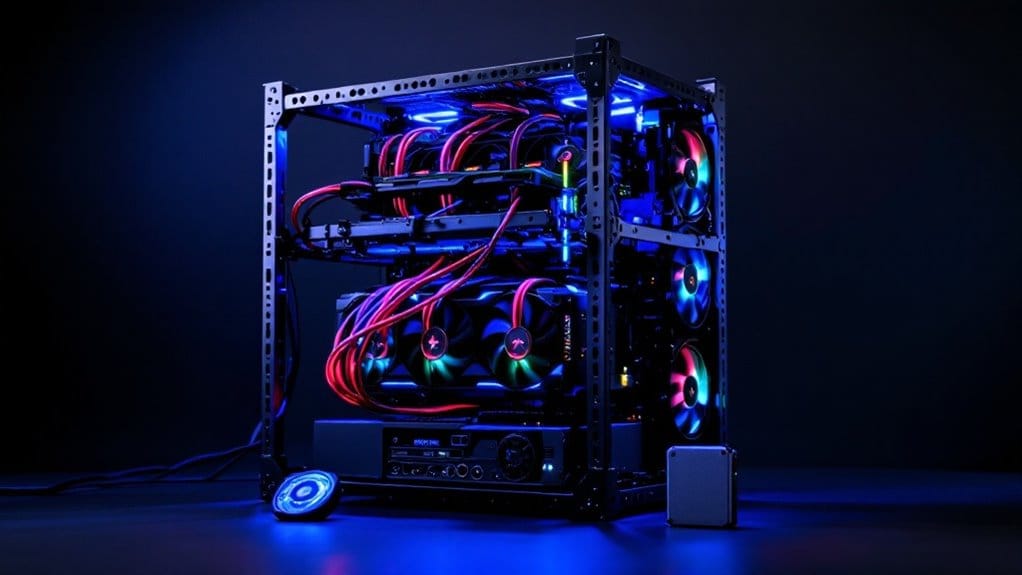
Before you start dreaming of digital riches, you’ll need proper equipment. At minimum, you’ll want either GPUs (for flexibility) or ASICs (for raw power). Beginners should consider budget-friendly options like the Nvidia GTX 1660 Super or AMD RX 570.
Don’t skimp on your power supply unit—a 600W is the bare minimum for a basic setup. Seriously, nothing kills mining dreams faster than fried components from a cheap PSU.
Your mining rig will need a modest CPU (Intel Pentium works fine), at least 4GB of RAM, and a small SSD for your operating system. Got all that? Great, now prepare for your electricity bill to make you question your life choices.
Profitability depends on three vital factors: hardware efficiency, electricity costs, and mining difficulty. Do the math before you start, not after.
Most newcomers should join mining pools rather than going solo. Think of pools as mining collectives—you combine computing power with others and share the rewards. Popular options include BTC.com, F2Pool, and Slush Pool. Using the SHA-256 algorithm, the mining pool collectively solves cryptographic puzzles to validate transactions. Successful miners receive block rewards that currently stand at 6.25 BTC per solved block.
Yes, they charge fees, but good luck earning anything meaningful without them.
The software side is less hardware-intensive but equally important. You’ll need specialized mining software to manage operations and optimize performance.
Don’t forget cooling solutions! Your expensive hardware will quickly become expensive paperweights without proper temperature management.
Internet connectivity is non-negotiable—you need a stable connection for synchronizing with the blockchain.
Mining difficulty increases over time, meaning yesterday’s profitable setup might become tomorrow’s money pit. Stay informed, be ready to upgrade, and remember: this industry rewards the adaptable, not the complacent. The Proof-of-Work system underpinning most mining operations ensures network security by making it economically unfeasible to alter transaction history.
Frequently Asked Questions
Is Cryptocurrency Mining Legal in All Countries?
Cryptocurrency mining is not legal in all countries. While many nations permit it, some have banned or restricted mining operations due to environmental concerns, energy consumption issues, or regulatory pressures.
How Much Electricity Does Mining Consume Monthly?
Cryptocurrency mining’s monthly electricity consumption varies widely, ranging from approximately 7-32 TWh. This fluctuates based on hardware efficiency, market conditions, difficulty levels, and mining locations. Precise estimates remain challenging due to operational variability.
Can I Mine on My Laptop?
Laptop mining is technically possible but impractical. It lacks sufficient computing power, risks hardware damage from overheating, consumes electricity inefficiently, and typically generates negligible profits compared to dedicated mining equipment.
Are There Tax Implications for Mining Cryptocurrency?
Cryptocurrency mining has significant tax implications. Miners must report mining rewards as income at fair market value upon receipt and pay capital gains taxes when selling mined coins after potential appreciation.
What Happens to Mining After All Coins Are Mined?
After all coins are mined, miners will shift to earning solely through transaction fees. Network security will depend on these fees providing sufficient incentive to maintain operations without block rewards.