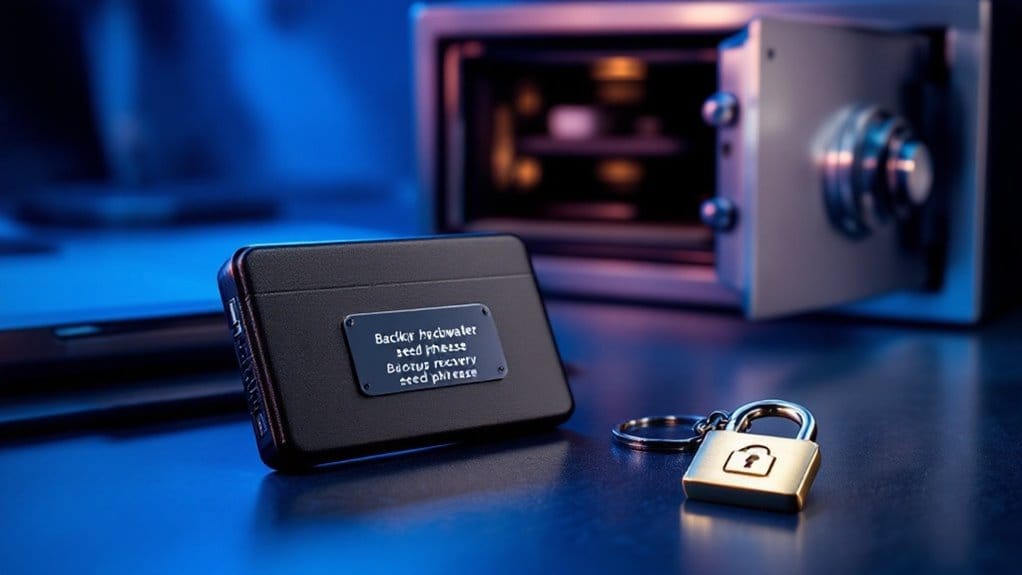

Hardware wallets are your best bet for crypto security—period. These offline devices keep your private keys away from hackers lurking online. Software wallets work for small amounts you’re actively trading, but never store your life savings there. Whatever you do, avoid keeping significant funds on exchanges (remember FTX?). For maximum protection, use the cold-hot combo: hardware wallets for bulk holdings, hot wallets for spending money. The strategies below will shield your digital fortune from virtual predators.

While cryptocurrency continues to revolutionize the financial world, it remains uniquely vulnerable to theft, hacks, and user error. With billions already lost to various threats, choosing the right storage method isn’t just good practice—it’s essential survival.
Hardware wallets represent the gold standard for crypto security. These physical devices store private keys offline, completely isolated from internet-based threats. Think of them as digital fortresses for your digital gold. They’re not cheap, but neither is losing your life savings to a hacker sitting in a basement halfway around the world. When making transactions, these devices verify and sign transactions without exposing your private keys online, ensuring maximum security.
Your crypto keys, your financial sovereignty. Offline storage isn’t just smart security—it’s financial self-defense in the digital age.
Software wallets offer more convenience but less security. Connected to the internet, these “hot wallets” make transactions easy but expose your assets to online risks. Use them for small amounts you actively trade—not your retirement fund. Remember: convenience always costs something in the security department.
Exchange wallets might seem convenient (hey, your crypto is just a login away!), but they’re fundamentally custodial services. Translation: someone else controls your keys. And in crypto, not holding your keys means not truly owning your coins. Just ask anyone who had funds on Mt. Gox or FTX how that worked out.
Smart investors adopt a combination approach. Store the bulk of your holdings in cold storage (hardware wallets or properly secured paper wallets), while keeping spending money in hot wallets. For those with significant investments, multi-signature wallets provide an extra layer of security by requiring multiple keys for any transaction. It’s the crypto equivalent of not walking around with your entire net worth in your back pocket. Jurisdiction compliance is also essential when selecting storage options, as local regulations may restrict certain wallet services.
Never, ever use public WiFi for crypto transactions. Protect your recovery phrases like they’re the nuclear codes—because to your financial future, they basically are. Store backup copies in separate physical locations, preferably in fireproof and waterproof containers.
The cryptocurrency space evolves rapidly, and so do the threats. Stay educated about emerging risks and security practices. What works today might not work tomorrow. The most powerful security tool isn’t digital at all—it’s your own knowledge and vigilance.
Frequently Asked Questions
What Is the Tax Implication of Moving Cryptocurrency Between Wallets?
Moving cryptocurrency between wallets is not a taxable event as it doesn’t constitute disposal of the asset. The original cost basis and holding period remain unchanged, though accurate record-keeping remains essential for future tax compliance.
Can Cryptocurrency Exchanges Be Hacked Despite Security Measures?
Yes, cryptocurrency exchanges can be hacked despite security measures due to vulnerabilities in infrastructure, human error, social engineering attacks, and smart contract exploits. Historical incidents like Coincheck, DMM Bitcoin, and GDAC breaches confirm this ongoing risk.
How Often Should I Update My Hardware Wallet’s Firmware?
Hardware wallet firmware should be updated immediately when released by manufacturers to address security vulnerabilities. Users should check for updates monthly and always follow manufacturer guidelines to maintain ideal protection against evolving threats.
Are Multi-Signature Wallets Necessary for Small Cryptocurrency Holdings?
Multi-signature wallets aren’t necessary for small cryptocurrency holdings. They offer enhanced security but add complexity and cost. For modest amounts, simple hardware wallets or well-secured alternatives typically provide sufficient protection without the additional operational burden.
What Happens to My Cryptocurrency if the Wallet Company Goes Bankrupt?
If a wallet company goes bankrupt, the outcome depends on custody type. With self-custody wallets, users retain access to funds through recovery phrases. Custodial wallet bankruptcies may leave users as unsecured creditors with limited recourse.