How would you feel if you tossed $100 million in the garbage? For James Howells, that nightmare became reality when he accidentally threw away a hard drive containing 8,000 Bitcoins in 2013. Those digital coins—initially worth pocket change—are now valued at a staggering £600 million. Talk about a costly mistake.
One man’s trash became a £600 million regret when James Howells accidentally discarded his Bitcoin fortune.
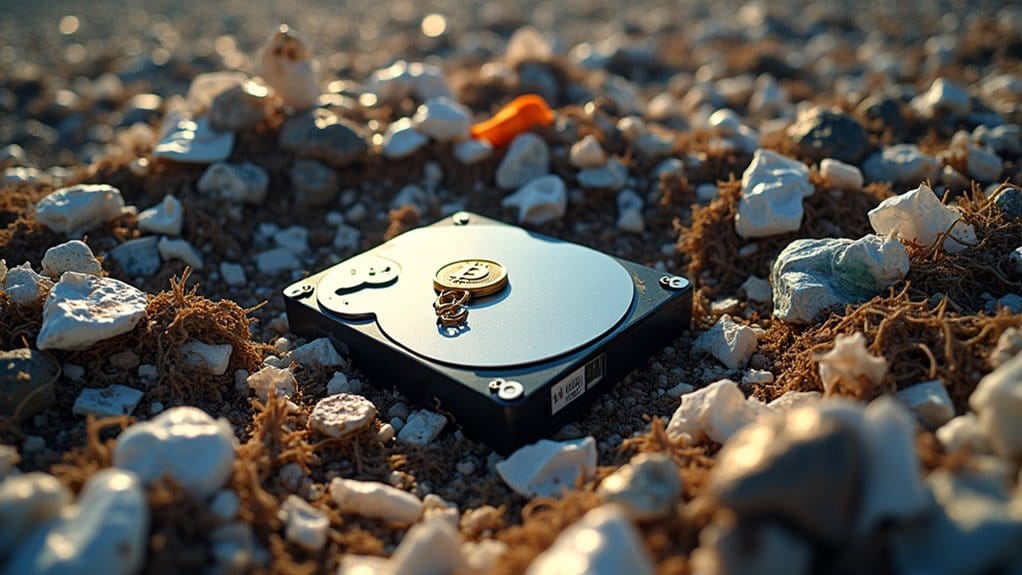
The hard drive sits buried under 1.4 million tonnes of waste at Newport’s Docks Way landfill in Wales. Finding it? About as likely as winning the lottery while being struck by lightning. Experts estimate the odds at one in 143 billion. Yes, billion with a “b.” The 2.5-inch drive occupies just 70 cubic centimeters in a landfill spanning 500,000 square meters. It’s the proverbial needle in a garbage-scented haystack.
Howells hasn’t given up. He’s offered the Newport City Council 25% of recovered funds plus an additional 10% community donation if they’ll let him dig. The council remains unmoved, citing environmental regulations that prohibit excavation. Their position? Sorry, but your financial catastrophe doesn’t trump ecological concerns.
Bitcoin’s meteoric rise has turned this into an international soap opera. Remember when 10,000 Bitcoins bought two pizzas back in 2010? Now a single coin exceeds $100,000. This value explosion transformed Howells’ mistake from an annoyance into front-page news. Investing in cryptocurrencies through reputable crypto exchanges would have been a far safer approach to protect his digital assets.
Legal battles have followed, with Howells seeking damages after courts ruled there were “no reasonable grounds” for his claim. The council stands firm: excavation simply isn’t permitted under their environmental license. The drive had been mistakenly discarded during an office cleaning when a miscommunication with his partner led to it being taken to the landfill. Period.
Howells now considers buying the entire landfill as a last-ditch effort. The expected value calculation actually makes sense—if search costs stay below £1.9 million and take less than a year, the potential reward justifies the investment. Adding urgency to his mission, the Newport City Council plans to close the landfill permanently by 2025 and transform part of it into a solar farm.
Next time you toss something, check twice. Your junk might be tomorrow’s fortune. And if you own cryptocurrency, for heaven’s sake, back up your wallets—multiple times, in multiple places. Don’t become the next cautionary tale of digital wealth gone literally to waste.