
ERC20 tokens are standardized digital assets built on Ethereum’s blockchain. Created in 2015 and formalized in 2017, they follow a specific recipe with six vital functions that guarantee seamless transfers between wallets. Think of them as identical digital coins that play nice with thousands of applications. They power everything from stablecoins to governance systems, making them essential for DeFi operations. Despite some scalability issues, ERC20 remains the gold standard for fungible tokens in crypto’s evolving landscape.
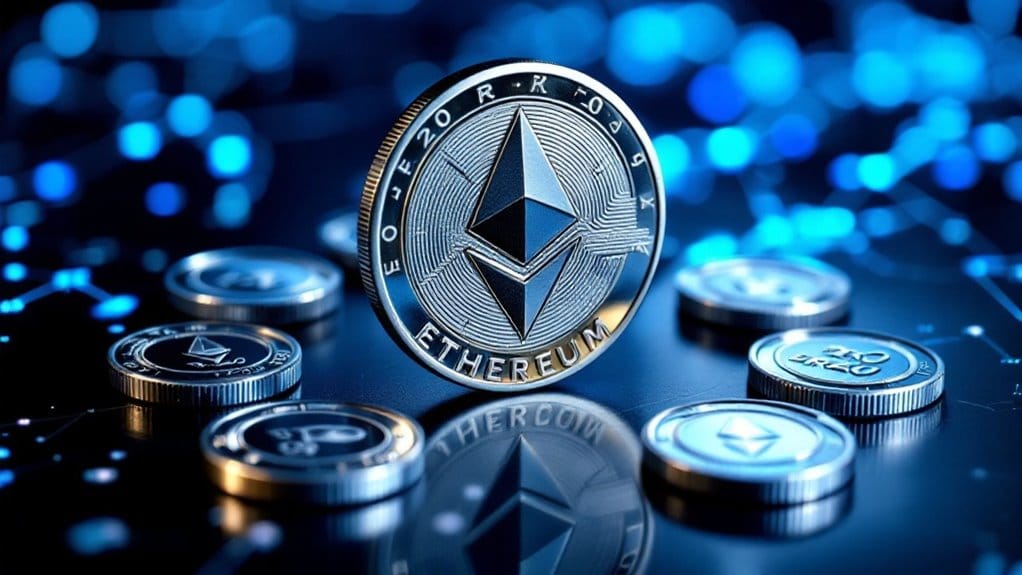
Confusion reigns supreme when newcomers plunge into the crypto world, but understanding ERC20 tokens doesn’t have to be rocket science. These tokens, whose name derives from “Ethereum Request for Comment 20,” represent a standardized way to create fungible tokens on the Ethereum blockchain. Proposed in 2015 by Fabian Vogelsteller and formalized in 2017, this standard quickly became the backbone of Ethereum’s thriving token ecosystem.
Think of ERC20 as a recipe that developers follow. This recipe includes six essential functions: totalSupply, balanceOf, transfer, transferFrom, approve, and allowance. When a token includes these functions, wallets and exchanges know exactly how to handle it – no guesswork required. It’s like speaking a common language that everyone in the Ethereum neighborhood understands.
What makes these tokens special? Their fungibility, for starters. Unlike those fancy NFTs, each ERC20 token is identical to others of its kind – just like how one dollar equals another dollar. They’re also transferable, which means you can send them between addresses without breaking a sweat. Some ERC20 tokens function as bridge currencies between the volatility of cryptocurrencies and traditional financial systems.
These tokens power everything from digital currencies like Basic Attention Token to governance systems where tokens represent voting rights. They’re the workhorses of decentralized finance (DeFi), enabling lending, borrowing, and trading without middlemen controlling your assets.
Don’t mistake their simplicity for weakness. ERC20 tokens offer remarkable transparency – all transactions are visible on the blockchain. They’re also incredibly interoperable, working seamlessly across thousands of applications and wallets. With over half a million tokens issued to date, the ERC20 standard has proven its remarkable staying power in the crypto ecosystem.
But they’re not perfect. ERC20 tokens inherit Ethereum’s scalability issues and sometimes hefty gas fees. Security risks lurk in poorly coded contracts, and the market’s saturated with thousands of tokens of questionable value.
As Ethereum evolves, so too will its token standards. Popular ERC20 implementations include stablecoins like Tether (USDT) and USD Coin (USDC) that maintain price stability through various mechanisms. Newer alternatives address various limitations, but ERC20 remains the gold standard for fungible tokens. Master this concept, and you’ve revealed a fundamental building block of the entire crypto ecosystem.
Frequently Asked Questions
How Secure Are ERC20 Tokens Against Cyber Threats?
ERC20 tokens face vulnerabilities like reentrancy attacks, integer overflows, and front-running. While SafeMath libraries and proper auditing can mitigate risks, their security ultimately depends on the underlying contract implementation and developer practices.
Can ERC20 Tokens Be Converted to Other Cryptocurrencies Easily?
Converting ERC20 tokens to other cryptocurrencies typically requires intermediaries like exchanges or bridge protocols. While straightforward for popular tokens, conversion complexity varies based on the target cryptocurrency and available cross-chain infrastructure.
What Happens to ERC20 Tokens During Ethereum Network Upgrades?
ERC20 tokens remain largely unaffected during Ethereum network upgrades. The underlying standard maintains compatibility, ensuring tokens continue functioning normally while the network improves its consensus mechanism or performance without disrupting token operations.
Are There Tax Implications Specific to ERC20 Token Transactions?
ERC20 token transactions have specific tax implications. They’re taxable events requiring reporting of capital gains/losses. Token swaps, airdrops, and staking rewards all create tax obligations based on fair market value at receipt time.
How Do ERC20 Tokens Impact Ethereum’s Environmental Footprint?
ERC20 token transactions contribute to Ethereum’s environmental footprint by requiring gas fees and network resources. However, Ethereum’s shift to proof-of-stake has markedly reduced this impact compared to previous proof-of-work mechanisms.